
Glascock Scheduled Versus Actual Release
A scheduled or projected date is an estimate based on the current sentence, credit, custody status, and release rules. An actual release date records what happened. The two may differ because a court changes the sentence, credit is corrected, parole action changes, misconduct occurs, a detainer takes effect, or another authority assumes custody. A date in the past may describe departure from one agency without proving freedom in the community.
| Status | What it means | Best source |
|---|---|---|
| Pretrial | No set sentence end; release may depend on bond or court action | Holding jail and court |
| Local sentence | Date depends on the court order and holder's computation | Actual holding jail and sentencing court |
| GDC sentence | Computed sentence data may coexist with parole timing | GDC and Parole Board |
| Released | Physical custody ended for that agency | Release entry and receiving-agency check |
Find a Glascock Release Date
Glascock is listed as “NO JAIL” in the Georgia Sheriffs' Association report, so there is no local jail computation policy to assume. For a Glascock arrest, the Sheriff's Office can identify where a person was booked or held. That holding jail and the court order are the correct sources for a local date. For a state prisoner, use GDC and the Board rather than the county.
- Call the Glascock County Sheriff's Office at 706-598-2881 and ask where the person was physically held. Use the full name and case or arrest number when known.
- Ask the holding jail for current custody status, the projected or scheduled date if one exists, and the basis shown in its record. Confirm whether the event is release or transfer.
- Check the sentencing or bond order with the Glascock court. A pretrial person may have a bond condition but no fixed release date.
- For state prison custody, use the GDC Offender Query. Match the GDC ID, case information, physical details, and sentence fields.
- Use the Board TPM explanation and lookup for parole timing. Do not report a TPM as a final release date.
- Verify state data in writing with GDC Inmate Records and Information when the date affects court or release planning.
The Georgia VINELink inmate check process can watch for a custody change, but it does not replace the jail, GDC, or court computation.
Glascock GDC Date Fields
The Georgia Department of Corrections offender search is used when a Glascock case resulted in state prison. Search results may show the name, GDC ID, case number, physical descriptors, location or release status, sentence details, and a maximum possible release or sentence-end field when available. Photographs may appear automatically, but the photo and date must both be matched to the same offender.
GDC warns users to verify information through written correspondence with Inmate Records and Information at P.O. Box 1529, Forsyth, Georgia 31029. This matters when several sentences overlap, a court recently amended an order, or a displayed date appears inconsistent. The online value is a search aid, not a new court order.
Georgia.gov's Find an Offender overview shows the official route into the state search.
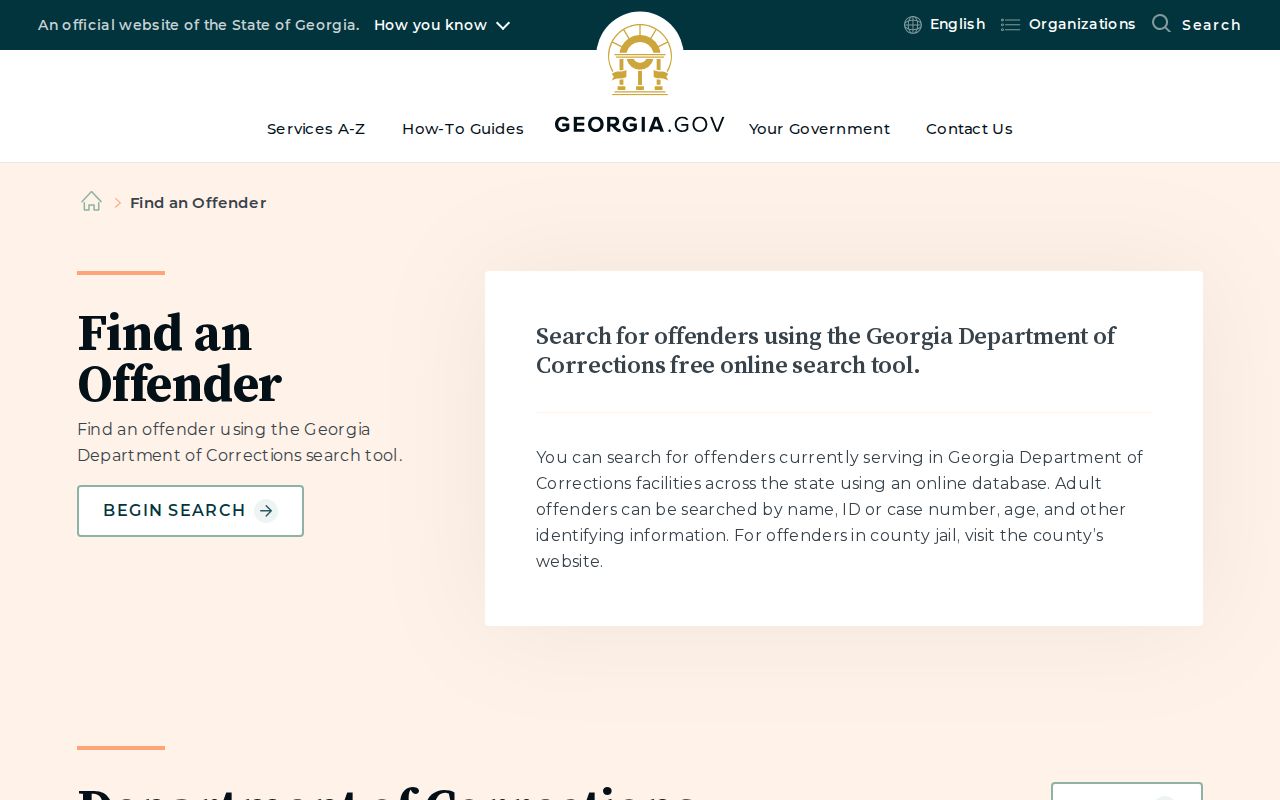
The state route applies to GDC custody and released state offenders, not a short stay in an out-of-county holding jail.
Georgia Sentence Computation for Glascock
Georgia Rules and Regulations Subject 125-2-4 supplies the sentence-computation framework. The crime date controls which rules apply. For crimes on or after January 1, 1984, the rule describes “straight time” for sentences other than life and death, with court-set start and end points adjusted by the applicable computation factors.
- Sentence begin date
- The effective start date, including applicable jail time served.
- Sentence end date
- The effective termination date after sentence length and authorized adjustments.
- Non-running time
- Time added for events such as escape, toll time, appeal bond time, or an intervening federal sentence.
- Controlling sentence
- The sentence that determines the operative computation when more than one sentence exists.
- TPM
- A tentative parole month for final Board review, not a guaranteed release date.
These terms explain why adding a sentence length to a conviction date can be wrong. Jail credit, concurrent or consecutive terms, and periods when the sentence does not run must be resolved from the official computation. A county estimate cannot substitute for GDC's record.
Glascock Good-Time and PIC Rules
Georgia does not support a single broad “85 percent” answer for every offense. Different rules cover sentence computation, parole eligibility, serious violent felonies, and incentive credits. O.C.G.A. section 42-5-101 authorizes work incentive credits for eligible felony prison terms other than life. Credits may reflect education, vocational progress, work performance, and satisfactory behavior. GDC reports them to the Board for final parole decisions.
The GDC Performance Incentive Credit program says eligible offenders can earn up to 12 points and may receive one to twelve months off a TPM or maximum release date. PIC is a GDC program. It is not a Glascock county-jail good-time rule, and no local Glascock computation policy was found.
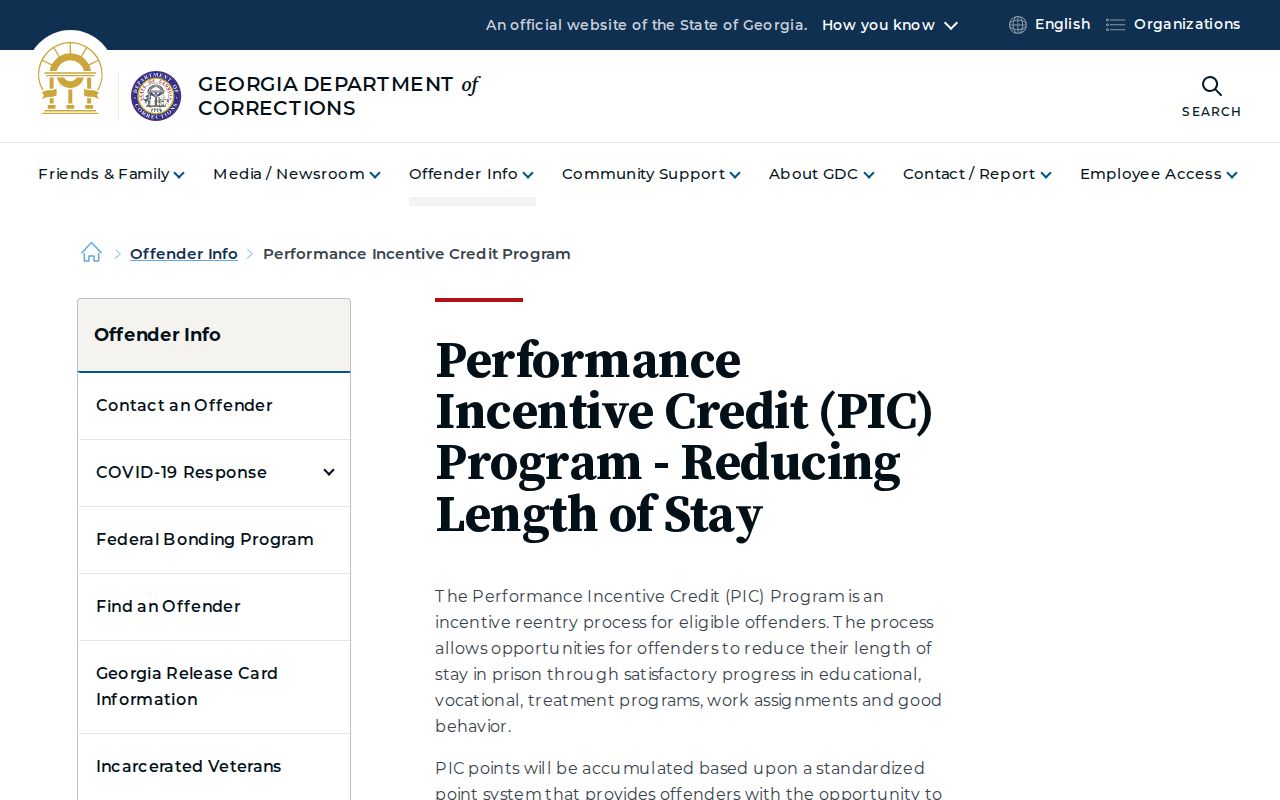
The official PIC description ties credits to eligible state offenders and specific program performance, so an expected reduction should be confirmed in the individual GDC and Board record.
Glascock Serious-Felony Release Limits
O.C.G.A. section 17-10-6.1 creates offense-specific limits for serious violent felonies. Covered sentences may not be reduced through parole, earned time, early release, work release, leave, or other sentence-reducing measures, apart from limited transitional provisions described by law. That is the researched truth-in-sentencing issue for Georgia. A generic percentage should not be applied to all Glascock cases.
Life-sentence timing also depends on the offense and date. The Board's parole process describes seven-year eligibility for certain pre-1995 “seven deadly sin” offenses, fourteen years for 1995 cases, and thirty years for covered offenses on or after July 1, 2006. Eligibility only permits consideration. It does not require release.
O.C.G.A. section 42-9-45 gives general eligibility points for other cases: the reviewed text states six months or one-third of a misdemeanor sentence, whichever is greater, and nine months or one-third of a felony sentence, whichever is greater, subject to other statutes. The Board can accept or reject its guideline recommendation.
Why Glascock Release Dates Change
A projected date reflects facts known at the time. Each source should be checked again near the expected release, especially when court action, program completion, discipline, or another jurisdiction is involved.
| Change | Possible effect | Confirm with |
|---|---|---|
| Amended sentence or jail credit | Moves the computed begin or end date | Court and GDC or holding jail |
| Consecutive sentence | Adds time after another term | Court and sentence computation |
| Non-running time | Extends the end date | GDC records |
| PIC progress | May advance TPM or MRD for an eligible offender | GDC and Board |
| Misconduct or unmet program | May postpone or cancel parole timing | GDC and Board |
| Detainer or new custody | Changes destination despite release from one agency | Releasing and receiving agencies |
| Serious-felony restriction | Blocks ordinary early-release paths | Court, statute, GDC, and Board |
Confirm Glascock Actual Release
On or after the projected date, ask the custodian whether release occurred, the exact date and time, the release reason, and the destination. A missing roster entry is not enough. Glascock has no county jail roster in the official sources reviewed, and even elsewhere a person can disappear because of transfer.
For county-level custody, obtain the holding jail's release entry and compare it with the court order. For state custody, check GDC's released status and parole information. If a detainer is noted, check the receiving authority. The full Glascock County released inmate records route explains how to reconstruct the event across those custodians.
Read Glascock Date Terms Carefully
Concurrent sentences generally run at the same time, while consecutive sentences run one after another, but the judgment and official computation control the result. Jail credit can move the effective start point when authorized. An appeal bond, escape interval, or intervening federal sentence may create non-running time. Each factor should be traced to a court order or agency computation rather than guessed from the docket date.
Parole eligibility, a TPM, and a maximum release date are distinct. Eligibility marks when the Board may consider a person. A TPM marks a tentative month for final review. The maximum release date relates to sentence expiration under the official computation. None should be copied into a release plan without checking the current GDC record and any later Board decision.
When asking for a record, identify the exact field needed: projected date, maximum release date, TPM, sentence end date, release date, or destination. Include the full name, GDC ID or case number, and date of birth when allowed. A focused request reduces the risk that an office answers a different date question. If two dates conflict, ask each custodian for the source order and the date its system was last updated.
Public Record Search
Sponsored Results