
Glascock Parole Versus Probation
Parole follows release from a prison sentence. The State Board of Pardons and Paroles makes the parole decision, while the Georgia Department of Community Supervision, or DCS, supervises the person in the community. Probation is imposed by a court. It may begin without prison, follow a jail term, or form the community portion of a split sentence. DCS supervises felony probation and parole statewide. A misdemeanor case may use a local probation provider named in the court order.
The distinction controls where to verify a Glascock County record. The Board's Parolee Database is the released-person route for parole. A probation inquiry starts with the sentence filed by the Superior Court or the court that handled the case, then moves to DCS or the provider named in that order. Research found a private probation office in Thomson but no official Glascock court source naming it as the county provider, so the court record must settle that point.
| Point | Parole | Probation |
|---|---|---|
| Who orders it | State Board of Pardons and Paroles after a prison sentence | The sentencing court |
| Glascock verification | Parolee Database, Board records, and DCS | Court sentence, DCS for felony cases, or named local provider |
| Timing | Begins after parole release | May replace confinement or follow it |
| End record | Board discharge or other final parole action | Court or supervising-agency termination record |
- Parole
- Conditional release from prison before the sentence fully ends.
- Probation
- Court-ordered supervision in the community.
- Discharge
- The formal end of supervision under the controlling order.
- Absconder
- A supervised person alleged to have stopped reporting or left supervision without permission.
Check Glascock Post-Release Supervision
Begin with the custody path, not an assumption. A person who left a holding jail after bond may have no supervision, misdemeanor probation, or conditions set by a court. Someone who left GDC custody may be on parole, may have discharged the sentence, or may have transferred to another authority. Use a full name and another identifier whenever available because a name-only match can point to the wrong person.
- Check the Georgia Parolee Search when the person is believed to be out of prison on parole. Confirm the record with identifiers and note the status and dates shown.
- If the person still appears incarcerated, use the Board's Inmate TPM Lookup. A tentative parole month is a review marker, not proof of release.
- For probation, obtain the sentence from the Glascock County Superior Court Clerk or the court that handled the case. Read the supervision term and the named agency or provider.
- Contact DCS's Thomson Field Office to confirm the correct reporting office for felony probation or parole. Staff may require identifying or case information before discussing a record.
- When a status is unclear, compare the Board result, DCS information, court orders, and GDC custody status. A transfer, revocation, detainer, or new sentence can change what “released” means.
Glascock Supervision Reports to Thomson
Glascock County does not have a DCS field office in Gibson. The DCS Thomson Field Office serves Glascock along with Lincoln, McDuffie, Taliaferro, Warren, Wilkes, and the Toombs Circuit. That regional assignment is important. A person can be released, live in or have a case tied to Glascock, and report outside the county.
The office listing identifies Coordinating Chief Stacy Westberry. Use the main office number for routing and confirmation of the correct field office. Reporting instructions come from the officer or supervision order; an online office listing does not replace them.
Georgia DCS Thomson Field Office
Address:
1025 Warrenton Highway
Thomson, GA 30824
Phone: 706-595-7404
Fax: 706-595-1318
Hours: Monday-Friday, 8:00 a.m.-4:30 p.m.
The official Thomson listing shown below documents the office serving Glascock County.
Open the DCS Thomson Field Office source before reviewing the captured agency page.
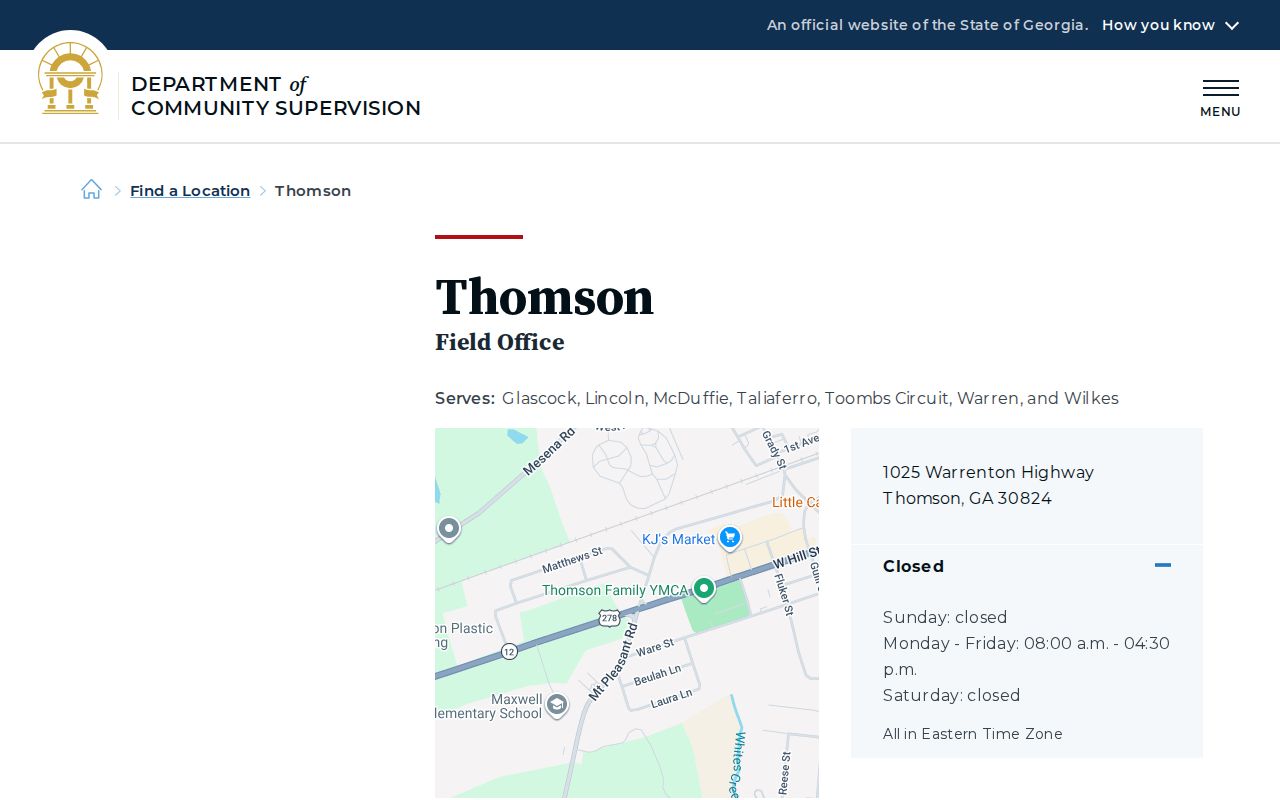
The regional service list explains why a Glascock parole or felony-probation record may point to Thomson rather than Gibson.
Glascock Parole Board Records
The State Board of Pardons and Paroles separates information about a person still in prison from information about a parolee. Its inmate lookup is used for parole consideration and TPM information. The Parolee Database is the better channel after a parole release. GDC's offender search can also link to parole or pardon status, but the Board is the decision source.
Board outcomes require careful reading. “TPM set” means a tentative month for final review. A parole release date is a later step and can still be withdrawn before it takes effect. Denied, deferred, postponed, canceled, rescinded, revoked, conditional transfer, and discharged describe different events. A conditional transfer to a detainer means custody moved to another authority, not that the person became free in the community.
Public monthly Board meetings are not case hearings. Notices may announce a meeting in Atlanta, but the Board states that individual offender cases are not considered at those public meetings. Case review instead follows the parole process, eligibility rules, file review, TPM tools, and Board records. For questions about eligibility or consideration, the Board lists its Parole and Corrections Call Center at 404-656-4661.
Glascock Supervision Conditions and Violations
Conditions are the rules in the parole certificate, probation sentence, or supervision plan. They can include reporting, approved travel, payment obligations, treatment, testing, or compliance with other court terms. The exact set belongs to the individual order. A general online result cannot show every current condition, and a court sentence may later be amended.
A claimed violation does not by itself prove that parole or probation ended. DCS may investigate, a warrant may issue, a court may hold a revocation hearing, or the Board may act on parole. “Absconder” generally means the agency alleges that the person stopped reporting or left supervision without permission. The official Glascock sheriff page did not show a public warrant list in the sources reviewed.
To verify an absconder or warrant claim, check the Parolee Database, contact DCS, review the court docket, and ask the Sheriff's Office about a public sheriff record. Do not rely on rumor or an old social post. A warrant can remain active after a person once appeared as released, and a person can return to custody after a violation.
Correct Glascock Supervision Records
An error must go to the custodian that created the disputed field. There is no single Glascock release desk that controls arrest, jail, court, GDC, Board, and DCS information. First identify whether the issue concerns an arrest, the actual holding jail's release entry, a sentence, a parole action, or current field supervision.
- Send arrest or transport errors to the Glascock County Sheriff's Office.
- Send booking and physical-release errors to the actual holding jail.
- Send disposition or sentence errors to the Superior or Magistrate Court custodian.
- Send prison custody and sentence-computation errors to GDC.
- Send parole decisions to the Board and field-supervision errors to DCS.
A correction request should name the field, identify the source record, and include the case, GDC, booking, or other reference number when known. It should ask for review of the existing record, not assume that the record can be erased. Georgia retention schedules preserve many parole case materials for 20 years, while clemency actions such as parole certificates, revocation orders, and certain discharge orders are permanent.
When Glascock Supervision Ends
Release from a jail or prison and discharge from supervision are separate events. A person may leave physical custody yet remain subject to parole or probation. Supervision ends only under the applicable Board, court, or agency order. The final record may be a Board discharge, a court entry showing probation complete or terminated, or an agency status update.
Check the authority that imposed the supervision. For parole, use the Board and DCS records. For felony probation, compare the sentencing order with DCS status and later court entries. For misdemeanor probation, ask the court which provider holds the completion record. If the person was transferred or revoked, a “released” entry from an earlier custodian may no longer describe the current status.
The broader Glascock County released inmate search and records process explains how sheriff, holding-jail, court, GDC, and federal records fit together. That custody history helps distinguish a true supervision discharge from a mere release or transfer.
Preserve Glascock Discharge Proof
Keep copies of the sentence, parole certificate, later modification, and final discharge when available. Dates can look inconsistent when one portal updates before another. A direct written request can resolve a historical Board action that no longer appears in a simple name search. Georgia retention schedules support that route because core clemency actions remain permanently retained even after a live supervision result changes.
The Thomson office is a field-supervision contact, not the release-record custodian for every Glascock arrest. It does not replace the actual holding jail's release entry or the court's sentence. If the person moved or supervision transferred, ask which DCS office currently owns the case. For a closed case, request the final order from the authority that ended supervision and compare its date with the last online status.
Public Record Search
Sponsored Results